
Blast RADIUS: How "Access-Reject" Became "Access-Accept"
Somewhere on the wire, a packet that should have said "No" learned to say "Yes".
Your Password Is Wrong#
The server knows it’s wrong.
It sends back an Access-Reject.
Everything worked exactly as designed.
Except…
you still get in.
No stolen credentials.
No brute forcing.
No leaked shared secret.
Somewhere between the client and the server, a packet that was supposed to deny access quietly transforms into one that grants it. The client verifies its authenticity, trusts it completely, and opens the door.
If that sounds impossible, you’re not alone.
For nearly three decades, network engineers believed this couldn’t happen.
Until Blast RADIUS proved otherwise.
The Protocol Everyone Trusted#
For over thirty years, one protocol quietly authenticated billions of network logins.
If you’ve ever connected to enterprise Wi-Fi, logged into a VPN, or authenticated to a network device, there’s a good chance RADIUS was involved.
Designed in the early 1990s, the Remote Authentication Dial-In User Service (RADIUS) became the de facto authentication protocol for enterprise networks. Today it sits behind corporate Wi-Fi, VPN concentrators, routers, switches, firewalls, Linux PAM, ISP infrastructure, and global roaming services like eduroam.
It isn’t flashy.
Most users never realize it’s there.
Yet every day, billions of authentication requests quietly pass through RADIUS servers around the world.
Most deployments still use RADIUS over UDP, carrying forward a design made in an era when MD5 was considered state-of-the-art cryptography. At the time, it was a perfectly reasonable engineering decision.
Protocols, however, often outlive the assumptions they were built on.
Three decades later, that decision became RADIUS’s greatest weakness.
The Packet Nobody Questions#
Every authentication protocol has to answer one fundamental question:
How do you know the response actually came from the server?
Without some way to verify authenticity, anyone capable of intercepting network traffic could simply fabricate an Access-Accept packet and bypass authentication altogether.
RADIUS solves this using something called the Response Authenticator.
Every Access-Accept, Access-Reject, and Access-Challenge packet contains this value. It acts as a cryptographic fingerprint computed from several packet fields, the original Request Authenticator, and a shared secret known only to the client and the server.
Response Authenticator =
MD5(
    Code ||
    Identifier ||
    Length ||
    Request Authenticator ||
    Attributes ||
    Shared Secret
)The client performs the exact same computation after receiving the response.
If both values match, the packet is accepted.
If they don’t, it is silently discarded.
At first glance, this mechanism appears extremely difficult to defeat.
The shared secret is never transmitted across the network.
An attacker can observe every packet exchanged between the client and the server but without the secret, they seemingly have no way to generate a valid Response Authenticator.
That’s exactly why the protocol survived for so long.
A Real RADIUS Response#
A simplified Access-Reject packet looks roughly like this:
Code          = 3 (Access-Reject)
Identifier    = 0x71
Length        = ...
Authenticator = e3 42 9d ...

Attributes
    Reply-Message
    Session-Timeout
Proxy-StateWhen the client receives this packet, it doesn’t blindly trust the server.
Instead, it recomputes the Response Authenticator using the shared secret.
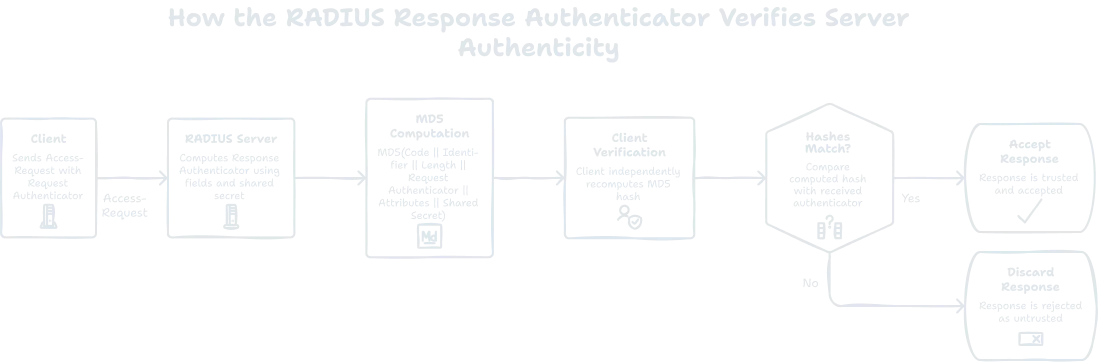
The beauty of the design lies in its simplicity.
The server proves it knows the shared secret without ever revealing it.
For nearly thirty years, that guarantee seemed unbreakable.
Everything appears secure.
The attacker doesn’t know the shared secret.
The server never reveals it.
The client verifies every response independently.
So where does Blast RADIUS fit into all of this?
The answer isn’t hidden inside the secret.
It’s hidden inside a quiet assumption the protocol made about MD5. That assumption remained true for decades, until cryptography finally caught up.
Enter Blast RADIUS#
Every exploit begins with a question everyone else stopped asking.
For years, the weaknesses of MD5 were no secret.
Researchers had demonstrated collisions. Browsers had abandoned MD5 certificates. Cryptographers had repeatedly warned against using it for new designs.
Yet RADIUS remained largely untouched.
Why?
Because knowing that MD5 is broken doesn’t automatically let you forge a valid RADIUS response.
Every Response Authenticator still depends on a shared secret known only to the client and the server.
Without that secret, forging a valid hash appears impossible.
That assumption held until researchers asked a different question.
What if we don’t need to know the secret at all?
Instead of attacking passwords…
Instead of attacking encryption…
Instead of attacking the server…
Blast RADIUS attacks the protocol’s trust model.
An attacker positioned between the client and the RADIUS server doesn’t need to decrypt packets or recover credentials. They simply manipulate a legitimate authentication exchange until the client accepts a response the server never intended to send.
Not by breaking authentication.
But by exploiting the way authentication is verified.
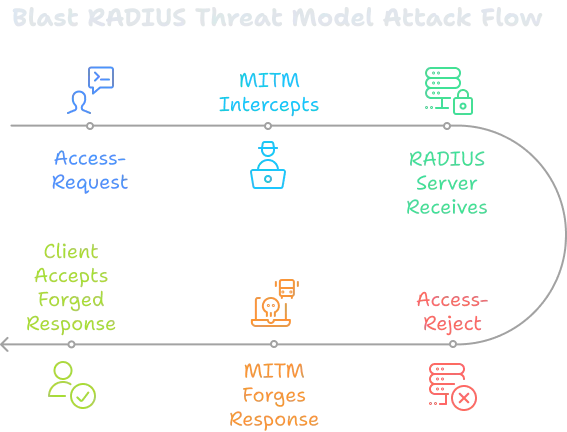
At first glance, this sounds impossible.
If the attacker cannot compute the Response Authenticator…
how can they possibly produce a packet that passes verification?
The answer isn’t hidden in the shared secret.
It’s hidden in the mathematics of MD5 itself.
Why the Secret Isn’t Enough#
The protocol trusted the secret.
The attacker trusted mathematics.
The security of the Response Authenticator rests on a simple assumption:
Appending a secret to the end of a message should prevent anyone from forging a valid hash.
Unfortunately, cryptographic hash functions don’t work that way.
Blast RADIUS relies on a technique known as a chosen-prefix collision.
Unlike a traditional collision, where two arbitrary messages happen to produce the same digest, a chosen-prefix collision allows an attacker to begin with two completely different messages and carefully construct additional data so that both eventually produce an identical MD5 hash.
Think of it like this.
Imagine two novels.
One ends with the hero surviving.
The other ends with the hero dying.
They tell completely different stories.
Yet somehow, after adding hundreds of carefully chosen pages to each, both books end up with the exact same fingerprint.
That’s the power of a chosen-prefix collision.
Even now, the attack still appears impossible.
After all, the shared secret is appended after the packet contents.
Wouldn’t that produce different hashes?
This is where MD5’s design becomes important.
MD5 processes data sequentially.
It doesn’t understand messages.
It only understands bytes.
Once two carefully crafted inputs reach the exact same internal state, feeding both of them the same remaining bytes causes them to stay synchronized.
The shared secret isn’t protecting the collision.
It’s simply more input.
As a result…

The attacker never discovers the shared secret.
They never guess it.
They never recover it.
They simply rely on the fact that the same unknown value is appended to both colliding messages.
That’s the subtle observation Blast RADIUS builds upon.
It transforms a weakness in MD5 into a weakness in the protocol itself.
For the first time, the attacker has something they never had before.
Not the shared secret.
Not the server’s private state.
But the ability to construct two different RADIUS responses that produce the exact same Response Authenticator.
There is only one problem left.
Chosen-prefix collisions require hundreds of carefully crafted bytes.
RADIUS packets aren’t designed to carry arbitrary data.
So where do you hide a collision without breaking the protocol?
Hiding a Collision in Plain Sight#
Sometimes the safest place to hide something is where nobody thinks to look.
The hardest part of Blast RADIUS isn’t generating the collision.
It’s fitting that collision inside a valid RADIUS packet.
Chosen-prefix collisions aren’t small.
They typically require hundreds of bytes of carefully generated data.
If those bytes were inserted into most RADIUS attributes, the server would reject the packet long before the Response Authenticator was ever checked.
Blast RADIUS solves this problem using one of the protocol’s least interesting attributes.
Proxy-State.
Defined for RADIUS proxies, Proxy-State allows intermediary systems to attach opaque metadata to authentication requests.
The server doesn’t interpret its contents.
It doesn’t validate them.
It simply copies the attribute into the corresponding response exactly as it was received.
That tiny implementation detail becomes the attacker’s hiding place.
The attacker intercepts the victim’s Access-Request, appends a malicious Proxy-State attribute containing the collision blocks, and forwards the request to the server.
The server authenticates the user as usual.
Completely unaware that it is carrying attacker-controlled data.
When the response is generated, the server faithfully echoes the Proxy-State attribute back.
Exactly as the RFC requires.

Now both responses
the legitimate Access-Reject
and the forged Access-Accept
contain the exact same collision blocks in the exact same location.
The server computes only one Response Authenticator.
The attacker never computes either.
Instead…
they convince the server to compute a hash that is valid for two different packets.
The packet was never supposed to open the door.
It only had to convince the client that it already had.
Watching Blast RADIUS Happen#
Every packet is telling the truth.
Just not the same truth.
Up to this point, we’ve explored each piece of the attack in isolation.
The Response Authenticator.
Chosen-prefix collisions.
Proxy-State.
The shared secret.
Individually, none of them are vulnerabilities.
Blast RADIUS emerges only when those pieces interact.
Let’s follow a single authentication exchange from beginning to end.
Phase 1: A Normal Authentication Request#
Everything begins with an ordinary Access-Request.
A user enters the wrong password while connecting to a corporate Wi-Fi network.
The client creates an authentication request, includes a randomly generated Request Authenticator, and sends it toward the RADIUS server.
Nothing about the packet is unusual.
If you captured it in Wireshark, it would look exactly like thousands of legitimate authentication requests.
At this point, neither the client nor the server knows an attacker is sitting between them.
Phase 2: The Attacker Changes One Thing#
The request passes through the attacker.
Nothing is removed.
No credentials are modified.
No headers are forged.
The attacker simply appends a Proxy-State attribute containing the carefully generated collision blocks before forwarding the request.
To every compliant RADIUS implementation, Proxy-State is just opaque metadata.
The server has no reason to reject it.
The authentication process continues exactly as it would have otherwise.
From the user’s perspective, nothing has happened.
Phase 3: The Server Rejects the Login#
The RADIUS server receives the request and validates the credentials.
They’re incorrect.
The correct response is an Access-Reject.
The server constructs the response exactly as defined by the protocol, computes the Response Authenticator using the shared secret, and then copies the Proxy-State attribute into the response exactly as RFC 2865 requires.
Every step is correct.
The server behaves exactly as it was designed to.
Phase 4: The Packet Swap#
The Access-Reject never reaches the client.
Instead, it reaches the attacker.
This is the only active step in the entire exploit.
The legitimate response is discarded.
In its place, the attacker forwards a precomputed Access-Accept.
The server never generated this packet.
The attacker never computed its Response Authenticator.
Yet the packet carries a Response Authenticator that the client will accept as valid.
The server answered one question.
The client received another answer.
Phase 5: The Client Verifies the Wrong Packet#
The client receives an Access-Accept.
It doesn’t know the packet was swapped.
Like every compliant RADIUS implementation, it performs a single verification.
Does the Response Authenticator match?
The answer is yes.
The packet is accepted.
The login succeeds.
The network believes the server approved the authentication.
It never did.
The packet should have said “No.”
By the time it reached the client, it had learned to say “Yes.”
The Trick#
At first glance, Blast RADIUS looks like a broken integrity check.
It isn’t.
The integrity check works exactly as designed.
The Response Authenticator is valid.
The client verifies it correctly.
The server generated it legitimately.
Nothing in the verification process fails.
The attacker simply changes which packet that cryptographic proof is attached to.
Blast RADIUS doesn’t defeat authentication.
It exploits an assumption authentication quietly relied on for three decades:
A valid cryptographic proof belongs to exactly one message.
MD5’s chosen-prefix collisions prove that assumption is no longer true.
One Picture#
If you’ve forgotten everything else in this article…
remember this.
                Normal Authentication

Client ─────────────► Server

                Access-Reject

Client ◄───────────── Server

          Authentication Failed


──────────────────────────────────────────────


                 Blast RADIUS

Client ───────► MITM ───────► Server

               Access-Reject

Client ◄────── MITM ◄────── Server
                  │
                  │ Replace Packet
                  ▼

              Access-Accept

       Response Authenticator ✓

Authentication SuccessfulEverything you’ve learned in this article, from the Response Authenticator to chosen-prefix collisions, exists to make one impossible outcome appear legitimate.
The server rejected the login.
The client accepted it.
The Bigger Lesson#
The exploit ends here.
The lesson doesn’t.
The easiest takeaway from Blast RADIUS is also the wrong one.
“MD5 is broken.”
That was already true.
Cryptographers had been warning against MD5 for years.
Browsers abandoned it.
Certificate authorities abandoned it.
Security engineers stopped designing new systems around it long ago.
Blast RADIUS didn’t reveal a new weakness in MD5.
It revealed something arguably more dangerous.
Protocols don’t usually fail overnight.
They fail gradually.
One assumption becomes outdated.
Another becomes fragile.
Eventually, a protocol that was once secure begins trusting guarantees that cryptography no longer provides.
A protocol can survive for decades without a single line of code changing, while the assumptions beneath it slowly erode.
RADIUS wasn’t compromised because someone wrote insecure software in 2024.
It was compromised because a protocol designed in the early 1990s continued trusting cryptography that no longer deserved that trust.
That’s a very different lesson.
And one that extends far beyond RADIUS.
More Than an MD5 Problem#
Blast RADIUS isn’t really about MD5.
It’s about composition.
Every individual component behaved correctly.
The server authenticated the request correctly.
The shared secret remained secret.
The Response Authenticator verified exactly as specified.
The client followed the RFC.
The server followed the RFC.
Even MD5 behaved exactly as MD5 was designed to behave.
Yet authentication still failed.
Not because one component broke.
Because all of them interacted in a way nobody anticipated thirty years ago.
Security engineers have a saying:
Secure components do not automatically compose into secure systems.
Blast RADIUS is one of the clearest demonstrations of that principle.
Why “Just Replace MD5” Doesn’t Work#
Ironically…
Replacing MD5 isn’t enough.
The Response Authenticator is baked into the protocol itself.
Simply replacing the hash algorithm would immediately make existing clients and servers incompatible.
Instead, the short-term mitigation focuses on removing the attack’s hiding place.
Vendor patches released after the disclosure reject or sanitize malicious Proxy-State attributes before they can participate in the collision.
The long-term solution is to stop relying on legacy RADIUS security altogether.
Modern deployments are gradually moving toward protected transports such as RADIUS over TLS (RadSec) and RADIUS over DTLS, where the protocol no longer depends on an MD5-based integrity mechanism.
Blast RADIUS didn’t just expose a vulnerability.
It accelerated a migration that should have happened years ago.
If You Remember One Thing…#
The password never changed.
The server never changed its mind.
The shared secret never leaked.
Only one thing changed.
The packet.
It left the server carrying one answer.
It arrived carrying another.
For nearly thirty years, RADIUS assumed those two moments were inseparable.
Blast RADIUS proved they weren’t.
Further Reading#
If this article sparked your curiosity, the original research is absolutely worth reading.
Unlike this write-up, which focused on building intuition, the paper dives deep into the cryptographic engineering that transformed decades of MD5 research into a practical protocol attack.
- Blast RADIUS: Breaking the RADIUS Protocol with MD5 Chosen-Prefix Collisions
- RFC 2865 Remote Authentication Dial In User Service (RADIUS)
- RFC 5080 Common RADIUS Implementation Issues and Suggested Fixes
- Marc Stevens’ HashClash project
- FreeRADIUS documentation and vendor advisories published after the disclosure